 English
 Français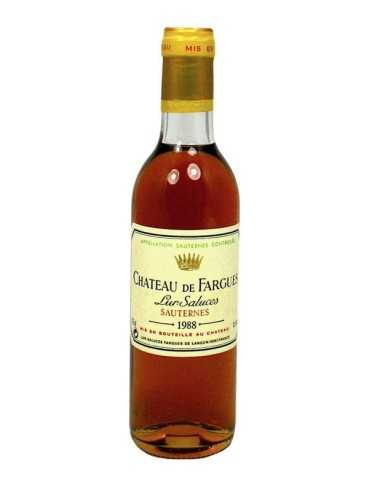
75.00 CHF

Filters (1 product)
France • Bordeaux • Sauternes • Château de Fargues • Lur Saluces Family • Sémillon • Sauvignon Blanc
Château de Fargues — The Timeless Nobility of Sauternes
Château de Fargues is one of the most distinctive and prestigious estates in Sauternes. Owned by the Lur Saluces family since 1472, it embodies an exceptional continuity of heritage, intimately linked to the history of Bordeaux’s great sweet wines.
Although the medieval château is rooted in a very ancient history, Château de Fargues’ modern vocation as a great Sauternes wine was shaped in the 20th century. The first significant plantings of white grape varieties date from the 1930s, and the estate’s first modern sweet-wine vintage is generally given as 1943. Since then, Fargues has become a major reference in the appellation, renowned for rare, intense, profound wines built for very long ageing.
The spirit of the château
An aristocratic and exacting vision of Sauternes. Château de Fargues seeks depth rather than immediate seduction, concentration rather than abundance, and the purity of noble rot rather than simple sweetness. Each vintage must reach the required level; when quality is not sufficient, the château may choose not to produce its grand vin.
History: Lur Saluces continuity since 1472
The history of Château de Fargues is first and foremost the story of a place and a family. The estate entered the heritage of the Lur Saluces family in 1472, at a time when the modern notion of great Sauternes wine did not yet exist. This rare family continuity gives the château a unique historical dimension in Bordeaux.
The château itself retains the aura of an ancient fortress, whose architecture recalls the estate’s seigneurial role before its modern winegrowing destiny. For a long time, the property was a diversified agricultural estate, before the potential of its soils and climate was fully directed towards great sweet wines.
In the 20th century, the Lur Saluces family undertook the decisive transformation of the estate. White grape varieties were planted on the best terroirs, and the production of Sauternes began with the first vintage in 1943. Alexandre de Lur Saluces, then the following generation, helped make Fargues one of the most demanding guardians of the classical Sauternes style.
Terroir: gravel, clay and the Sauternes microclimate
The Château de Fargues estate is extensive, but only part of it is planted with vines destined for the grand vin. Depending on the source, the planted vineyard is generally estimated at around 15 to 17 hectares, within a much larger property including woodland, meadows and other natural spaces.
The soils mainly combine gravel and clay, with a structure that encourages drainage, concentration and water regulation. This foundation allows grapes to ripen slowly while retaining the acidity needed for the balance of great sweet wines.
Like all great Sauternes, Château de Fargues depends on the controlled appearance of noble rot. Morning mists encourage the development of botrytis cinerea, while dry, luminous afternoons concentrate the berries. This delicate alternation gives birth to wines of exceptional intensity, but also great precision.
Terroir expression: Sauternes, Fargues, gravel, clay, botrytis cinerea, Sémillon, Sauvignon Blanc, concentration, freshness, spice and depth.
Fargues signature: extreme selection, low yields, noble botrytis, controlled richness, freshness, aromatic intensity and very long ageing potential.
Grape varieties and viticulture
Château de Fargues is classically planted with around 80% Sémillon and 20% Sauvignon Blanc. Sémillon forms the backbone of the wine: it brings volume, richness, texture, aptitude for botrytis and ageing potential. Sauvignon Blanc acts as an essential counterpoint, reinforcing freshness, aromatic brightness and tension.
Viticulture is guided by the search for perfect ripeness and pure botrytis. Yields are naturally very low, due to berry concentration and rigorous selection. At Fargues, quality always comes before quantity: the estate is known for its very high standards, including the decision not to release a vintage deemed insufficient.
Aromatic profile
Youth: candied apricot, roasted peach, mango, pineapple, candied orange, preserved lemon, white flowers, acacia honey and saffron.
Evolution: marmalade, beeswax, dried fruits, sweet spices, black tea, blond caramel, white truffle, almond and smoky notes.
Texture: dense liqueur, deep palate, structuring freshness, noble bitterness and a very long spicy finish.
Overall impression: a powerful, noble and complex Sauternes, less immediate than some, but remarkable for its depth, structure and ageing potential.
Harvest: successive tries and extreme selection
Harvesting at Château de Fargues is carried out by hand, through successive tries. The teams pass through the rows several times in order to select only berries affected by noble rot at the optimal stage. This method is long, costly and risky, but essential for producing great Sauternes.
Harvest: manual picking through successive passes, selecting botrytised berries at the optimal stage.
Yields: extremely low, sometimes summed up by the image of one glass of wine per vine.
Standards: only lots matching the desired quality level enter the grand vin.
Philosophy: produce little, but produce with precision, pure botrytis, deep liqueur and preserved freshness.
Vinification and ageing: power, time and precision
Highly concentrated juices ferment slowly, in a search for balance between richness, alcohol, acidity and residual sugar. Barrel ageing accompanies the wine’s natural density, polishing its texture and bringing refinement without masking aromatic purity.
The style of Château de Fargues is built on patience. These wines are not designed only to please in youth: they are made to evolve slowly, sometimes for several decades. Over time, the liqueur integrates, aromas gain complexity and the structure becomes increasingly noble.
Wine style
Château de Fargues produces a Sauternes of great intensity, often deeper, denser and more structured than immediately charming in youth. Its richness is evident, but supported by freshness that maintains balance and allows long evolution in bottle.
Great vintages develop remarkable complexity: candied fruits, honey, saffron, tea, wax, dried fruits, spices and truffled notes. Their ageing potential can be considerable, evolving slowly towards increasingly deep, almost meditative nuances.
Emblematic cuvées
Château de Fargues Sauternes: the estate’s grand vin, a blend of Sémillon and Sauvignon Blanc. A deep, intense, spicy and concentrated sweet wine built for very long ageing.
Old vintages: sought after for their ability to develop notes of wax, truffle, dried fruits, tea, saffron and marmalade.
Recent vintages: appreciated for their fruit purity, botrytised intensity, freshness and ageing potential.
Pairings and ageing potential
Château de Fargues naturally pairs with the great classic Sauternes matches: foie gras, blue cheeses, apricot desserts, citrus tarts or pastries with dried fruits. But its depth and freshness also allow pairings with roast poultry, spicy cuisine, sweet-and-savoury dishes and aged cheeses.
Ageing potential is one of the château’s great signatures. The best vintages can age for several decades, developing considerable aromatic complexity while retaining a surprisingly lively structure. Fargues is a Sauternes of patience, often even more impressive after many years in the cellar.
Key facts
Region: Bordeaux, Sauternes
Village: Fargues
Château: Château de Fargues
Owner family: Lur Saluces since 1472
First modern sweet-wine vintage: 1943
Planted vineyard: around 15 to 17 hectares depending on sources
Grape varieties: around 80% Sémillon and 20% Sauvignon Blanc
Soils: gravel and clay
Style: deep, intense, spicy, concentrated and fresh Sauternes, built for very long ageing
Particularity: the estate was not classified in 1855 because its modern production of Sauternes came after the classification, despite its current prestige.
In summary: Château de Fargues is one of the great names of Sauternes, owned by the Lur Saluces family since 1472. Its sweet wine, produced since the 1943 vintage, stands out for depth, concentration, freshness and immense ageing capacity.
Dominant aromas: candied apricot, roasted peach, mango, candied orange, preserved lemon, acacia honey, saffron, beeswax, dried fruits, black tea, blond caramel, white truffle, almond and a long spicy finish.
Current selection
Discover below the bottles from Château de Fargues currently available at World Web Wines, selected according to arrivals, vintage quality and the rarity of allocations.
